

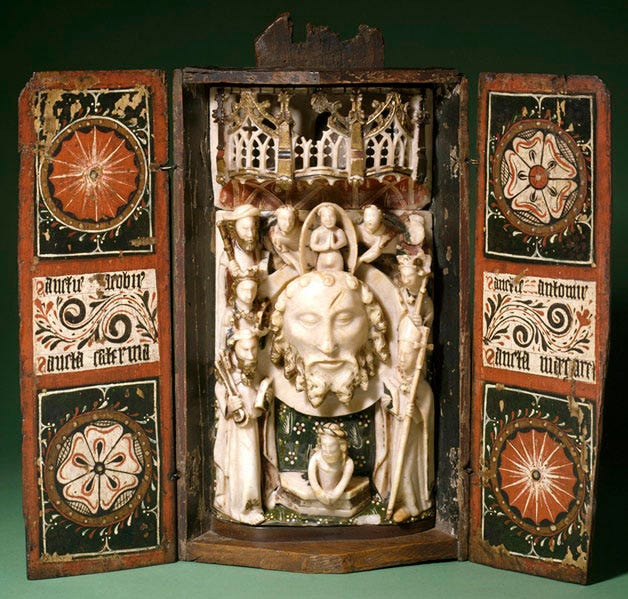
When we think of visual culture in the Middle Ages, Gothic churches and medieval manuscripts immediately come to mind. Painted alabasters probably don’t come to mind, despite the fact that they were ubiquitous in the late medieval world, especially in fifteenth century England. Few of these painted panels, altars, shrines, or tomb effigies survived the rage of the reformers in England; however, the Victoria and Albert museum managed to acquire a sizable collection from alabasters English workshops had exported across the continent.
According to Eamon Duffy, the most common devotional object in fifteenth century England was an alabaster tablet of John the Baptist’s head.1 I will discuss this image below, but first, I would like to touch upon the medium.
Until more recently, art historians have been uninterested in medieval alabasters, which seem crude compared to the masterpieces of the Renaissance. Still, these images are powerfully evocative, and have much to teach us today. It is worth trying to understand why they were so important to the devotional lives of the English people.
Historian Mathew Lyons wrote compellingly on them in a fascinating Substack post:
Look at these carvings today and you see a powerful and distinct kind of beauty, serene and often austere yet touched by a note of primitive wildness that is not primitive at all, instead being shaped by a sophisticated sensibility and idea of personhood which is simply other from our own.2
What is this idea of personhood? It is the idea that all persons in the Church Militant on earth and the Church Triumphant in heaven all live in the mystical body of the Church, praying together, united in Jesus Christ. The idea that the saints lived victoriously with Christ was not an abstraction for the fifteenth century English, for they saw signs of their presence everywhere.
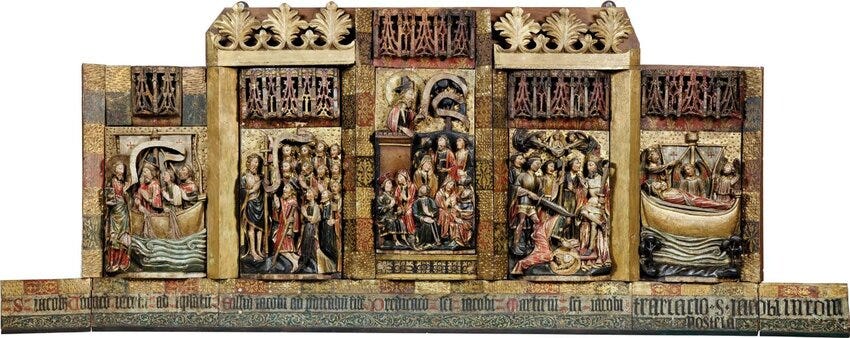
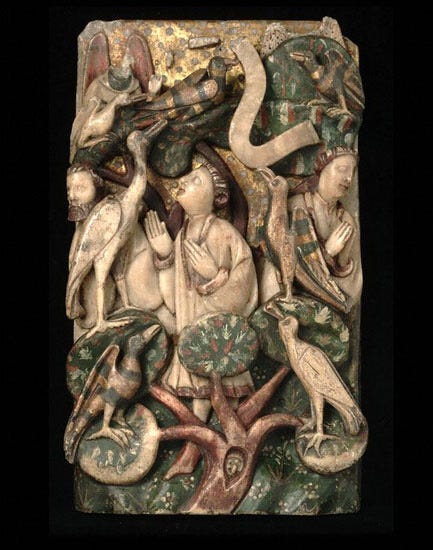
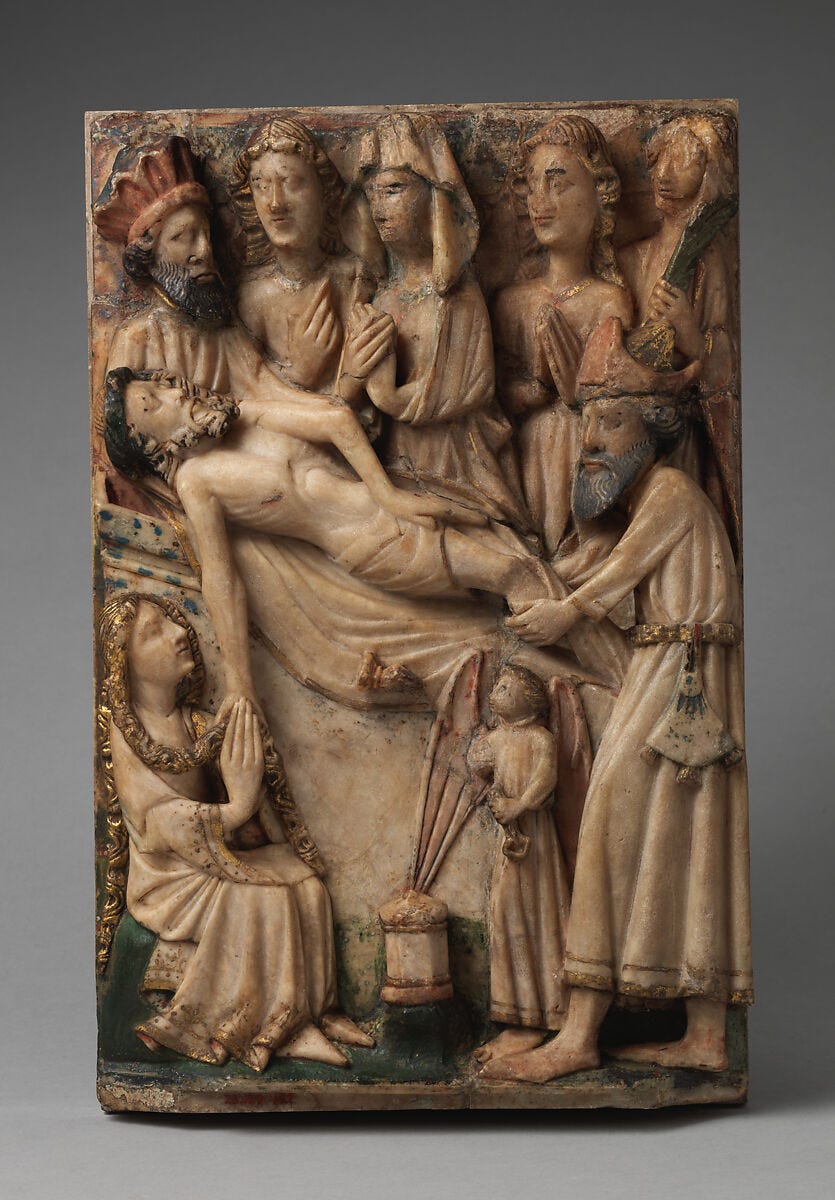
Alabaster was a popular material in the middle ages for many reasons. Because of its soft nature, alabaster proved relatively easy to carve, especially compared to materials like marble. It was also more abundant and had spiritual connections to the Gospels—Mary Magdalene held the oils she used to wash Christ’s feet in an alabaster container.
When carved and polished, it took on a mysterious luminosity, which would have especially been heightened when surrounded by candles. Mathew Lyons, explains why it was especially popular for funerary purposes:
Polishing alabaster figures brought out the material's haunting translucence, giving them an eerie, uncanny way of suggesting both life and death at the same time. Given human form, its pallor is all-too reminiscent of breathless, blood-drained, post-mortem flesh. And yet the play of light on alabaster features can seem a simulacrum of movement and life, the breath of God imagined as a limpid, liquid quality imbued in barren matter.3
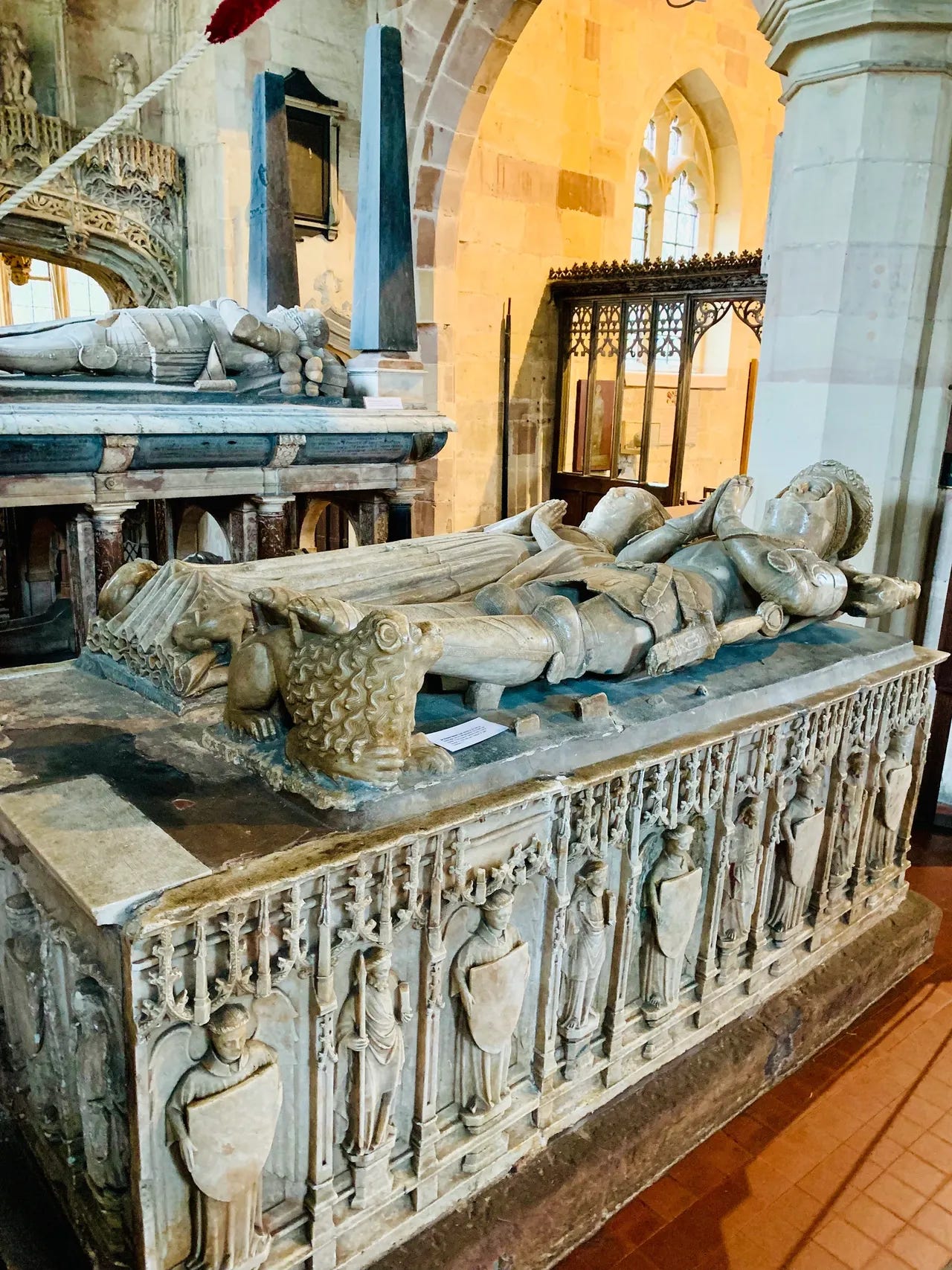
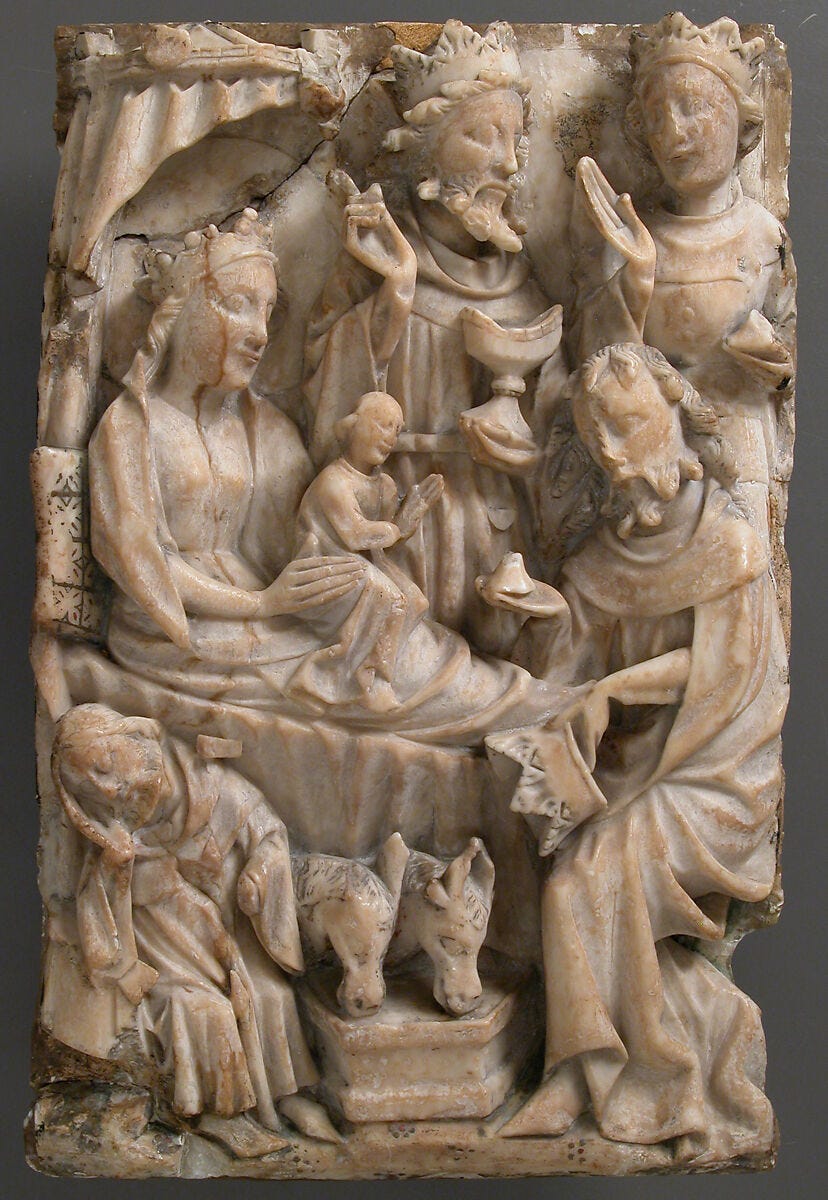
Under the flickering light of a candle, in a church, chapel or home, these alabaster images would have been powerful reminders of the presence of Christ and the saints, shepherding the laity into the presence of the sacred.
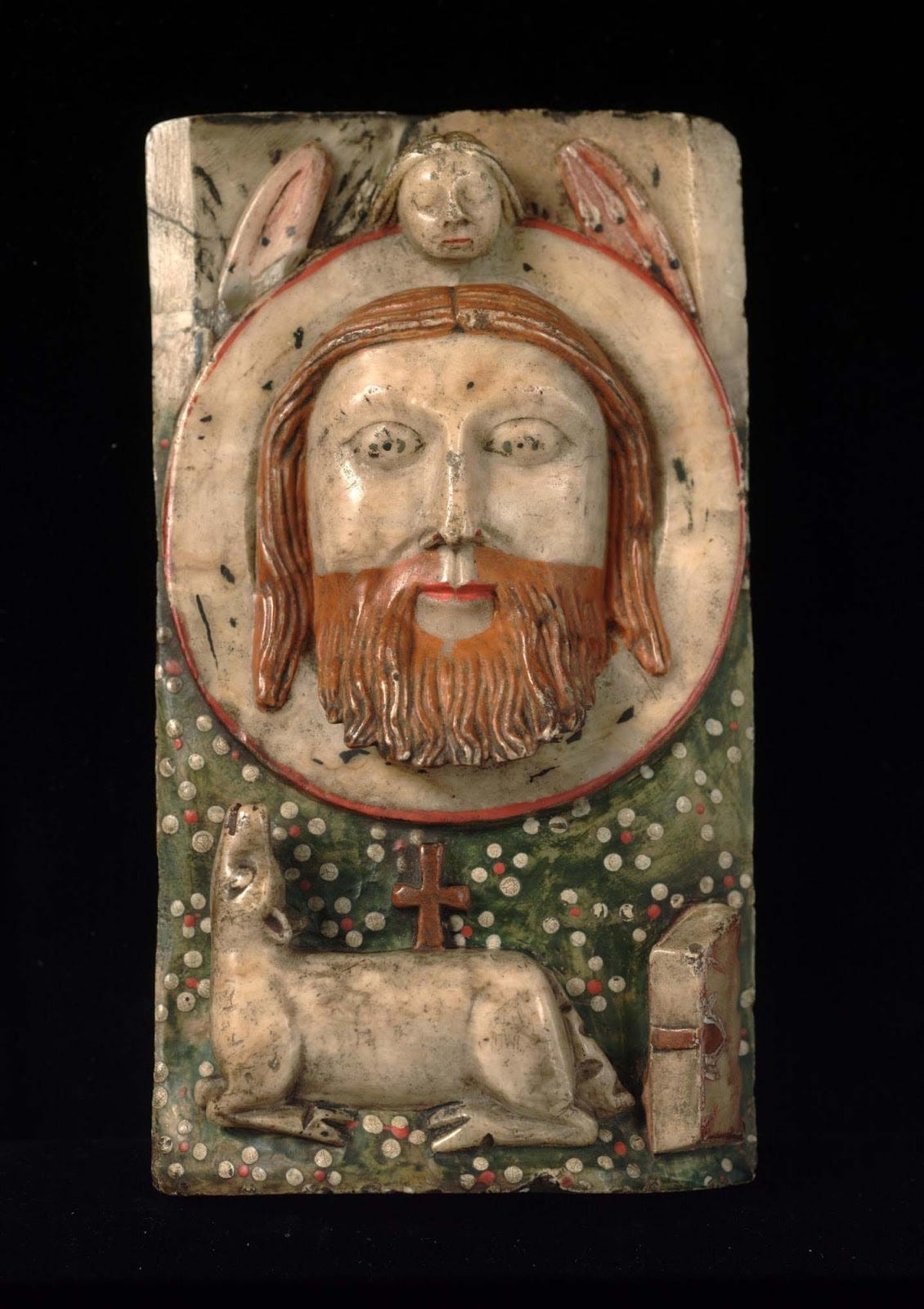
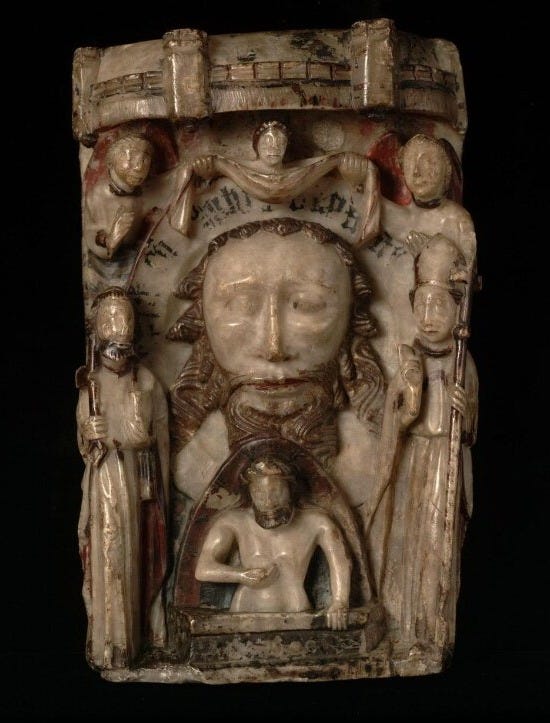
In the tablet below, Saint John’s head is framed by a charger and surrounded by an image of the Lamb of God or Christ as the Man of Sorrows as well as numerous angels and saints. Sometimes this image includes a depiction of John’s soul ascending to heaven with angels.
The main image—that of John’s head upon a charger—comes from the account in the Gospels. Although King Herod arrested John for rebuking his false marriage, he was also fascinated by the desert preacher and did not want to kill him. His wife, Herodias did and sent her daughter Salome to ask for his head on a platter after dancing for her father. Herod had John killed and presented John’s head to Salome. Legends say his body was burned, but that the apostles recovered his head, which had been struck by Herodias, and buried it. The feast of his decollation on August 29th celebrates both his martyrdom and the recovery of this relic.
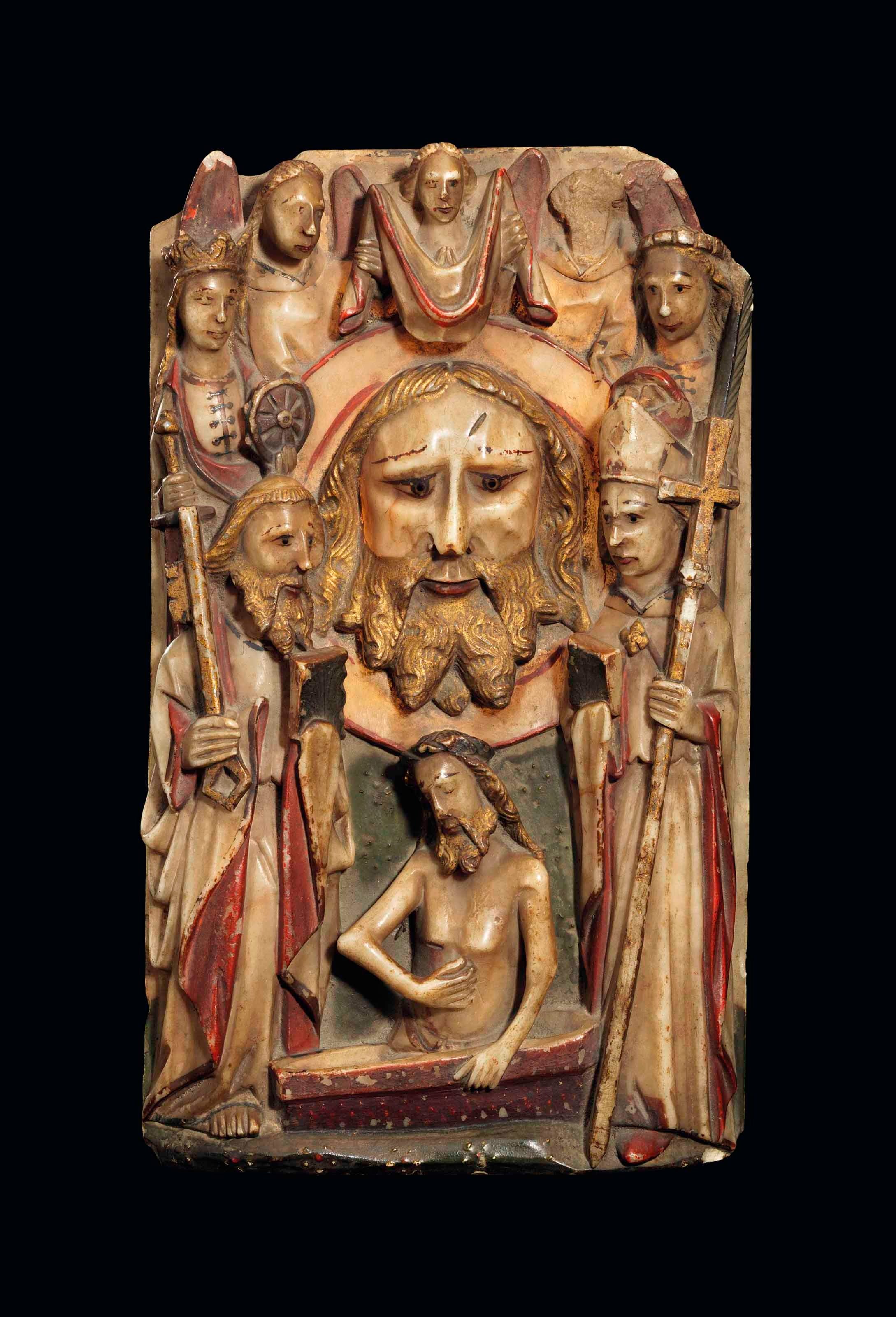
These “John heads” were created by hand, but in large supply. At only a shilling, both kings and peasants were able to afford these devotional objects, which would have assisted laymen at home as they prayed the hours with their families. There are simple and elaborate renditions of this image, made for homes and churches.
At first, this image may seem strange and it’s popularity curious. Why John the Baptist? Why this image of John the Baptist?
Today, many may find it surprising that Christ calls the Baptist “the greatest born of women” (Matthew 11:11). John the Baptist does not enjoy the prominence he once had, culturally or in the Mass—his name was mentioned 9 times in the traditional Roman rite. The new calendar does still celebrate his nativity and death.4
Saint John is not a polite Saint. It’s impossible to understand John, the forerunner, or his life without reference to Christ. As an ascetic, who spoke relentlessly of repentance, and died for his zealous preaching against a false marriage, the Baptist does not fit especially well in modernity.
While moderns may not embrace John, The fifteenth century English, on the other hand, loved him and named over 500 churches for him, not including monastic houses.5
St. John Crysostom’s description of Saint John the Baptist from the Golden Legend helps put his medieval popularity in perspective:
John the Baptist beheaded is become master of the school of virtues and of life, the form of holiness, the rule of justice, the mirror of virginity, the example of chastity, the way of penance, pardon of sin, and discipline of faith. John is greater than man, peer unto the angels, sovereign holiness of the law of the gospel, the voice of the apostles, the silence of the prophets, the lantern of the world, the foregoer of the Judge, and moyen of all the Trinity. And this so great a man was put to martyrdom, and gave his head to the adulterer, and was delivered to the springing maid.6
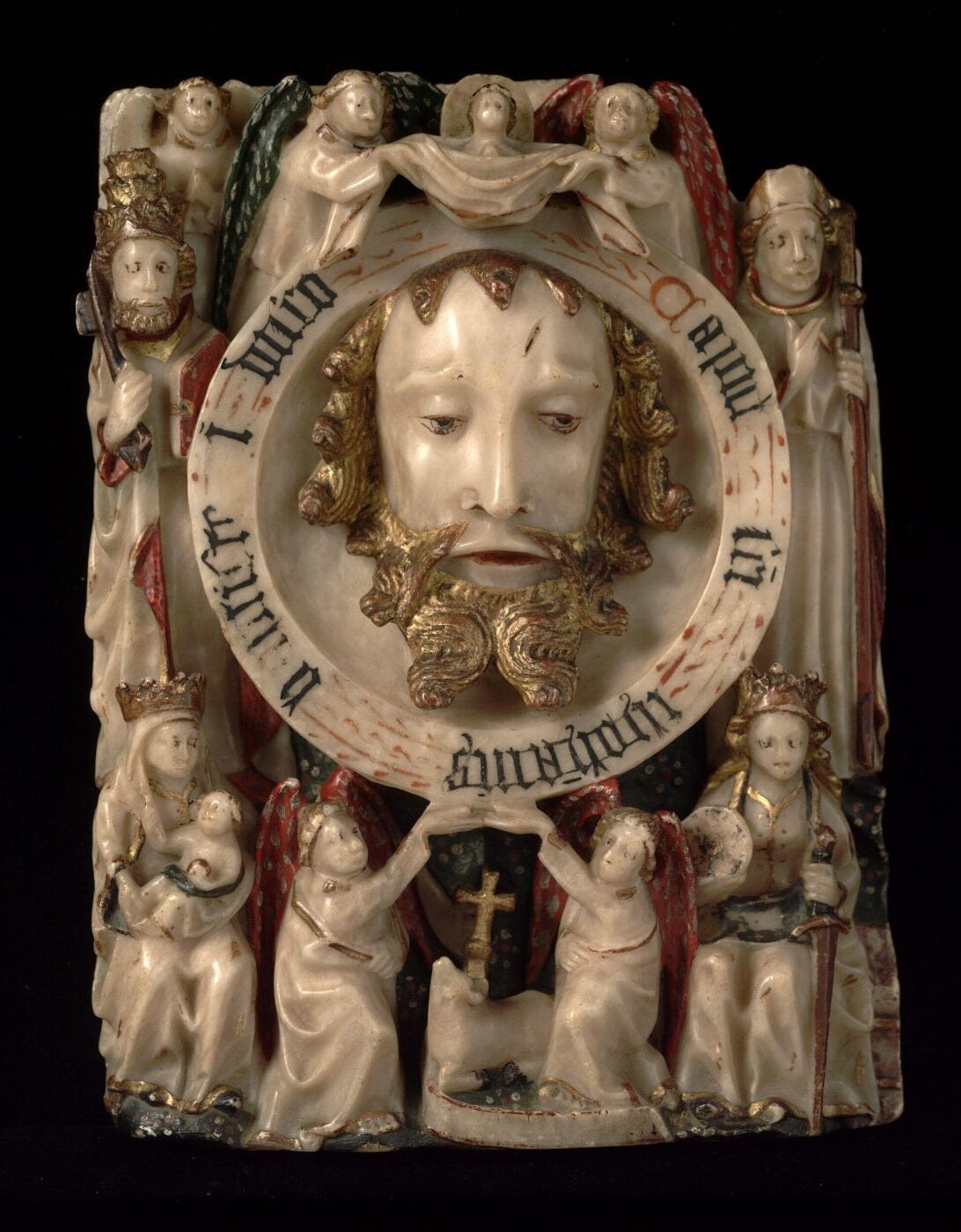
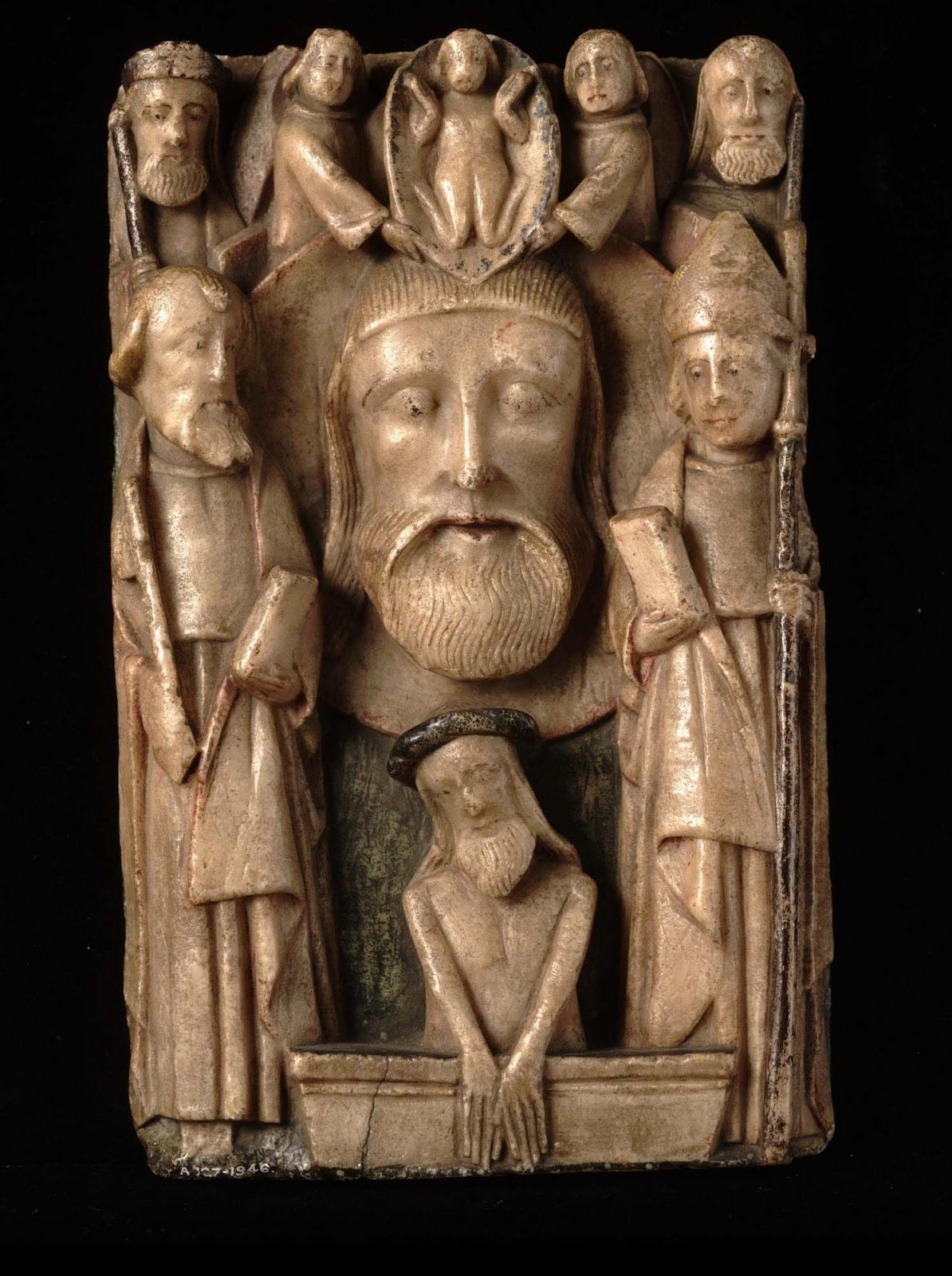
In the Bible, John’s voice, “the voice crying out in the wilderness,” was a sign, or a prefiguration, of Christ’s presence. According to a York breviary from the 1500’s, this particular image was a sign of Christ’s presence in the Eucharist. "St John's head on the dish signifies the body of Christ which feeds us on the holy altar."7
This connection would have also been highlited by the forerunner’s words, which are featured in the liturgy: “Behold, the lamb of God, who takes away the sins of the world/ Ecce Agnus Dei qui tollis pecca ta mundi.” This line, and the image of John and the lamb, bring to mind Christ’s sacrifice, which is made present for us in the Eucharist.
Not only was Saint John similar to Christ by his virtue, he was also related to Christ. Because of this, the medievals believed he looked like Christ. In fact, John’s face in these images, bearded and sorrowful, looks so similar to images of the Holy Face, for years, art historians mistook it for an image of Christ.
This physical semblance helps draw our attention to their spiritual semblance. As John’s sacrifice prefigures Christ’s, his head on the charger, prefigures Christ’s body on the paten in the Eucharist. His sacrifice brought him closer to Christ, through whom he was brought to Paradise to live forever with the angels and saints.
John’s head on the platter directs us to think of Christ’s physical body, but it also directs us to think of how we can offer our own sacrifice on the paten with Christ. It is an old custom for the laity to imagine putting themselves on the paten with Christ, uniting their sacrifice with his, during the offeratory at Mass. The image reminds us it is still worth doing.
A wonderful quote for the feast:
Eamon Duffy, Saints, Sacrilege and Sedition: Religion and Conflict in the Tudor Reformations, (London: Bloomsbury Publishing, 2012), 170.

See Peter Kwasniewski’s article: https://www.newliturgicalmovement.org/2024/06/the-prominence-of-st-john-baptist-in.html
Bond, Dedications and Patron Saints, 17
https://www.christianiconography.info/goldenLegend/decollationjohnBaptist.htm
Carr, "The Face Relics," 172.
I think these alabasters are really quite beautiful. Thanks, Amelia.
Thanks for linking to my piece. Amelia!